
Restoring Natural Aesthetics with Zirconia Crowns and E.max Veneers
A digital restorative case by Anna Allen of Lancaster Smile Clinic, in collaboration with GoDigital Dental Laboratory, Nottingham
Case Summary
Case: Aesthetic restoration of four upper anterior teeth
Treatment: Replacement central crowns and lateral veneers
Workflow: Intraoral scanning, digital wax-up, patient try-in and CAD/CAM manufacture
Restorations: Two zirconia crowns and two E.max veneers
Materials: Ivoclar zirconia and E.max ceramics
Design: Exocad CAD software
Outcome: Natural-looking restorations with improved proportions, shade and patient confidence
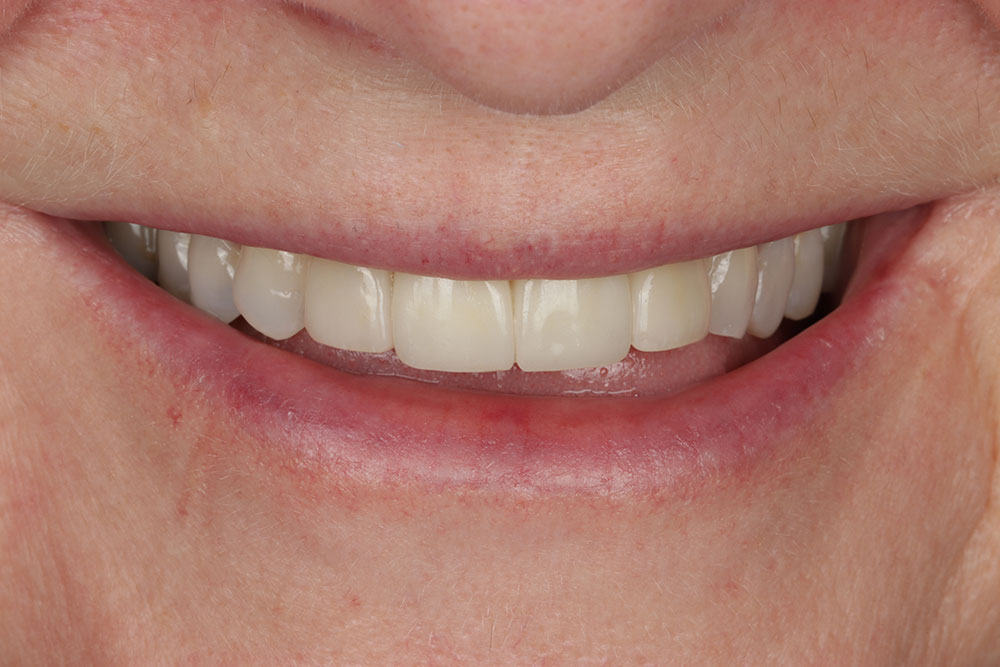
Restoring Confidence Through Digital Dental Design
When a patient is unhappy with the appearance of existing dental restorations, achieving a natural-looking result requires more than simply replacing the crowns or veneers. Tooth shape, proportions, shade and the relationship with adjacent teeth must all be carefully considered.
In this case, Anna Allen of Lancaster Smile Clinic worked with GoDigital Dental Laboratory to transform the appearance of a patient’s upper anterior teeth using a collaborative digital workflow.
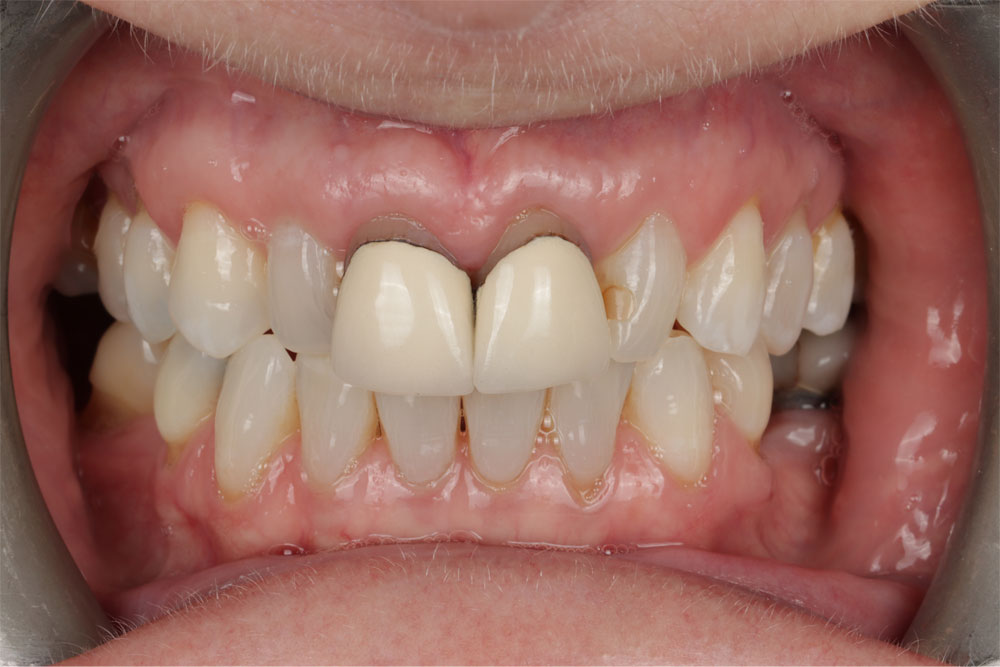
The patient was dissatisfied with the shape and proportions of their existing central crowns, while the shade of the ageing bonded metal restorations no longer blended naturally with the surrounding teeth.
Through digital scanning, CAD wax-up design, patient-led adjustments and precision-manufactured ceramic restorations, the team developed a treatment outcome tailored to the patient’s aesthetic expectations.
The result was a more balanced, natural-looking smile that restored the patient’s confidence.
Initial Intraoral Scanning and Digital Wax-Up
The restorative workflow began with an intraoral scan taken by Anna Allen at Lancaster Smile Clinic. The digital scan was sent directly to GoDigital Dental Laboratory for the initial design stage.
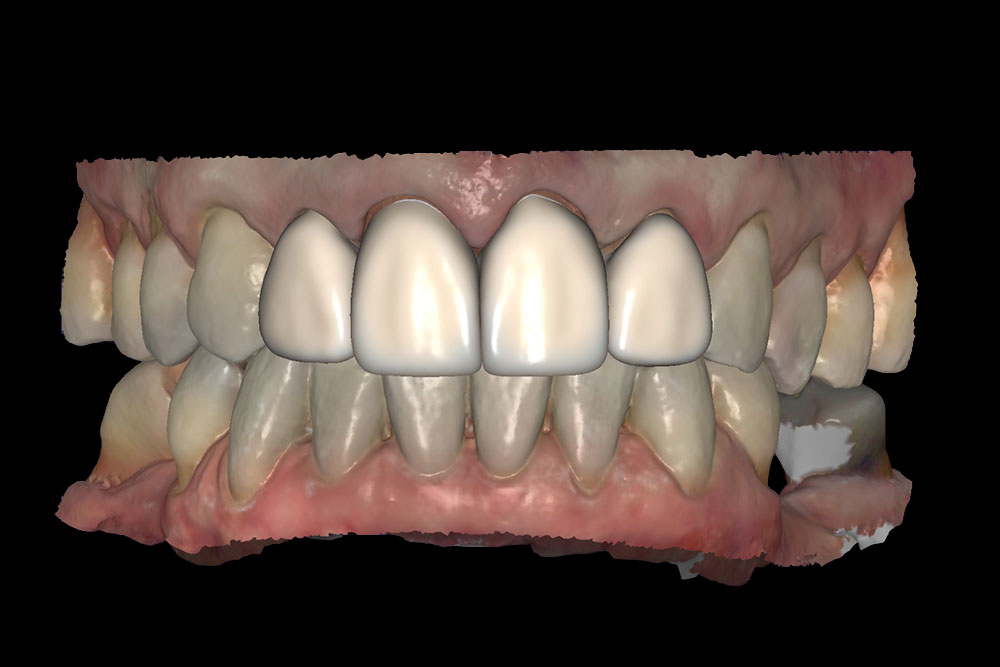
Using Exocad dental CAD software, Moritz created a digital wax-up to establish the proposed shape, length and proportions of the upper anterior restorations.
This initial design provided a visual representation of the proposed treatment, allowing the clinician to assess how the new restorations would complement the patient’s existing dentition.
The digital wax-up was shared with Anna for review and approval before progressing to the clinical try-in stage.
Initial Digital Wax-Up

Proposed Anterior Restorations

Patient Try-In and Refinement of the Design
Following approval of the initial wax-up, GoDigital Dental produced a putty stent based on the digital design.
The stent was sent to Lancaster Smile Clinic, where Anna used it to allow the patient to preview the proposed tooth shapes and proportions before the definitive restorations were manufactured.
This stage was particularly valuable because it gave the patient an opportunity to assess the design and request adjustments.
During the appointment, the patient asked for a slight alteration to the shape of the lateral incisors. Anna used composite material to refine the proposed design, allowing the patient to review the changes.
Once the patient was happy with the revised appearance, a new intraoral scan was taken and returned to GoDigital Dental.
This feedback process ensured that the final restorations reflected both the clinical requirements and the patient’s personal preferences.
Anterior Design Development

Lateral Veneer Design

Final CAD Design and Restoration Manufacture
Following receipt of the updated intraoral scan, GoDigital Dental refined the original Exocad design to incorporate the changes agreed during the patient try-in.
The revised design was returned to Anna for final approval before the case progressed to manufacture.
The treatment required two central crowns and two lateral veneers, with material selection playing an important role in achieving a consistent aesthetic result.
Central Crowns and
Lateral Veneers

Material Selection and Shade Management
The existing central crowns had presented an aesthetic challenge due to the darker underlying tooth shade.
Following removal of the old restorations, the prepared central teeth demonstrated why careful material selection and opacity management were necessary to achieve the desired result.
The new central crowns were milled from Ivoclar zirconia with an opaque core, helping to mask the underlying discolouration.
For the lateral incisors, E.max veneers were selected to complement the central restorations and achieve a natural appearance alongside the patient’s adjacent teeth.
Combining different restorative materials within the same anterior case required careful attention to shade, translucency and surface characterisation.
Underlying Tooth Shade

Ceramic Finishing and Characterisation
Following CAD/CAM milling, the restorations were passed to Jenna Ellis, GoDigital Dental’s Head of Ceramics, for finishing.
To address the darker underlying central tooth shade, Jenna applied an opaque treatment to the fitting surfaces of the crowns.
Staining and glazing were then carried out to refine the appearance of the restorations and create a natural shade match with the surrounding teeth.
This combination of digital dental laboratory technology and skilled ceramic finishing was essential to achieving a consistent result across the zirconia crowns and E.max veneers.

Fitting the Zirconia Crowns and E.max Veneers
Once the restorations had been manufactured and finished, they were returned to Lancaster Smile Clinic for fitting.
Anna completed the clinical stage by cementing the central crowns and lateral veneers into place.
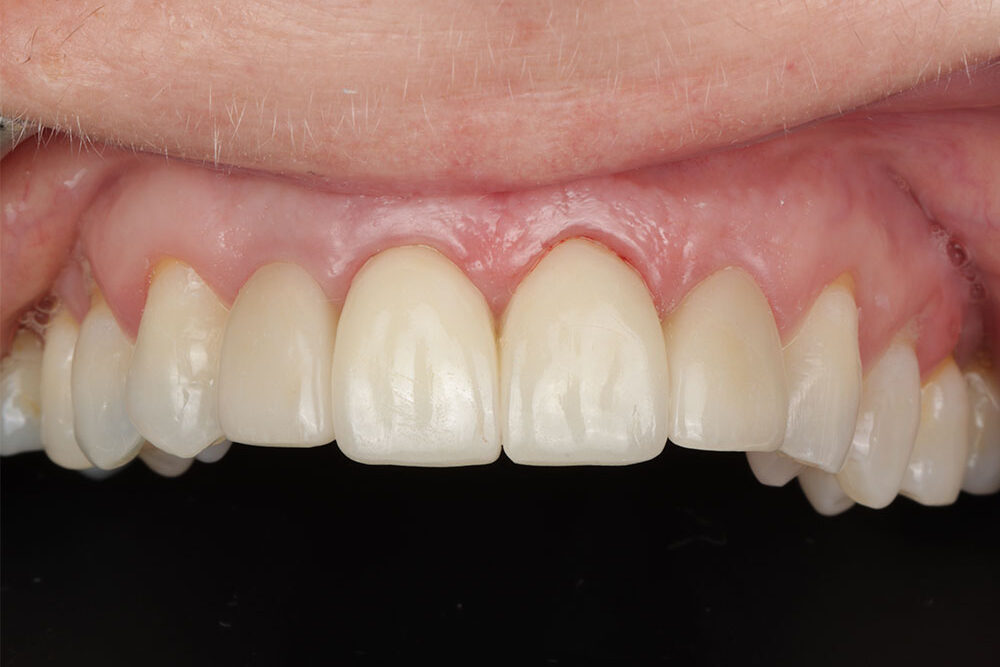
The final restorations incorporated the design adjustments requested during the patient try-in, improving the proportions and shape of the upper anterior teeth while maintaining a natural appearance.
The carefully selected ceramic materials and laboratory finishing helped achieve a consistent shade across the restorations and adjacent natural teeth.
A Natural-Looking Smile Through Digital Design and Clinical Collaboration
This case highlights the importance of close collaboration between clinician and dental laboratory in achieving natural-looking aesthetic restorations.
By combining digital scanning, Exocad design and patient-led refinements with carefully selected ceramic materials, GoDigital Dental Laboratory was able to produce restorations tailored to both the clinical requirements and the patient’s expectations.
The result was a balanced, harmonious smile that blended naturally with the surrounding teeth, restoring the patient’s confidence.
From initial design through to final ceramic finishing, the case demonstrates how digital dental laboratory technology and skilled craftsmanship work together to deliver personalised restorative solutions.
Case Study Before
Case Study Design
Case Study After
“Au naturel is always the goal – and with the help of Go Digital Dental Lab, we were able to achieve just that.
The result? A wider, more balanced and beautifully natural smile, proving that cosmetic dentistry doesn’t have to look ‘done’ to make a difference.
Natural. Minimal. Seamless.”
Dr Anna Allen (ARA)
Principle Dentist
Lancaster Smile Clinic
Credits to:
Clinical treatment:
Dr Anna Allen, Lancaster Smile Clinic
Digital CAD design:
Moritz Pohle, CAD/CAM Technician
Ceramic finishing:
Ms Jenna Ellis RDT, Ceramic Team Leader
Our Dental Lab Services
Advanced dental implant-based solutions for single implant, multiple implants, full-arch, All-on-X, full mouth restorations.
Crowns and bridges manufactured from monolithic zirconia, lithium disilicate, feldspar and hybrid ceramics.
Expertly crafted dental veneers, using advanced digital workflows, high strength premium materials, and precise CAD/CAM technology.
A professional implant planning service designed to give clinicians greater confidence, accuracy and predictability.
A bespoke shade taking service at our dental lab in Nottingham, with experienced technicians creating accurate dental products.
Using advanced technology we create a virtual image that allows both the dentist and patient to see the results before treatment begins.